
On Belonging
The comfort of lineage, the rituals of family, and how even the simplest traditions root us in love.

The photo is a little grainy. The blurred, bright orange date stamped vertically in the corner reads 12 30 ‘92. A toddler — me — stands barefoot on the brown carpet of my grandpa’s living room, wrapped in a ruffled dress of violet stripes and pastel florals. The hem sits slightly above my feet. The sleeves, puffed and proud, are trimmed in ruffles. My aunts sewed it by hand, one of several identical dresses for all the cousins. Together, I imagine we looked like a bouquet: matching ribbons, rosy cheeks, sugar-sticky fingers. The kind of childhood chaos that existed before phones could capture it from every angle and before moments became something we tried to keep instead of simply live inside.
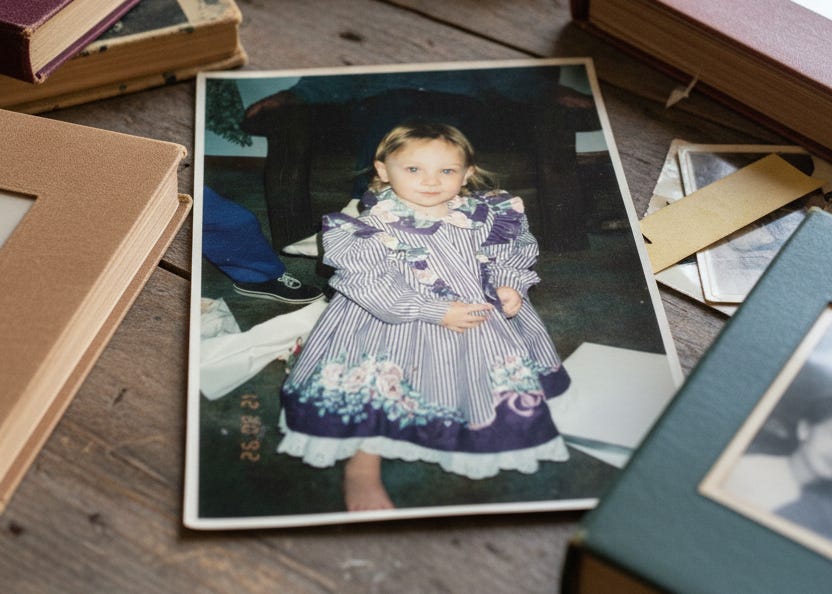
Now, decades later, my daughter wears that same dress. It hangs on her, a little oversized even though she’s almost a year and a half older than I was when I wore it. The colors, once vibrant, have softened with time; the fabric is delicate but still holds the memory of a little girl running wild in the living room so many years before.
I took a photo, of course. Bright lighting, toddler-made mess clearly visible in the background — preserved forever in the endless scroll of my camera roll. Her blue eyes sharp, her smile mid-laugh. The photo has clarity the old one never could, but sometimes I think the blur of the original means more. The imperfections, the haze, the faded edges — that feels closer to how memory actually lives inside us.
Family heirlooms are an enigma. They bridge time, but they also hold something we can’t quite name: the blur, the softness, the warmth of memory that’s bigger than the item itself. The dress isn’t just fabric; it’s the patience of women who gathered around a table, cutting and stitching with laughter and love in the air. It’s the echo of a childhood spent surrounded by cousins, of matching outfits and the illusion of sameness before life pulled us all in different directions.
Something about this season of motherhood makes me think often about those days — the unspoken rituals that threaded one year to the next.
The Christmas cookie days when flour covered every surface. The kitchen crowded with women talking over each other, timers beeping, frosting bowls the color of the eighties. The way someone always said “Don’t eat the dough,” and everyone did anyway.
The walking tacos at Labor Day street festivals, the faint pop of snappers hitting the sidewalk. The smoked chicken that can never quite be replicated unless it’s eaten on a blanket in a park in rural Iowa — the sound of aunts, uncles and grandparents laughing and cousins chasing each other barefoot around the merry-go-round.
The peonies laid gently on graves every Memorial Day, their petals heavy with dew, their scent hanging in the cool morning air. I can still see my aunts gathered around the flower bucket, reading the damp slips of paper tucked beneath rubber bands, trying to make out the names written in ink smudged and bleeding from the water that kept the stems alive. The same stories each year about the double-strength Kool-Aid and the search for shotgun shells after the 21-gun salute.
These are the small rituals that tether us to something steady, even as the world rushes on. The ones that don’t announce themselves as sacred, but somehow are.
And yet, somewhere along the way, we lose sight of them. Life grows louder, faster. We scatter across cities and states, busy with work and screens and calendars that never seem to align. The cookies come from the store. The peonies wilt in someone else’s yard. The old family recipes live in text threads we keep meaning to print. We tell ourselves we’ll bring back the traditions next year — when things slow down, when everyone can make it, when we have the energy.
But still, in quiet moments, we feel it. That pull. The ache for the familiar rhythm of belonging. The hum of voices in the kitchen. The way time used to bend around the people who came before us. The longing for the kind of togetherness that doesn’t need to be scheduled.
So I hold onto what I can. The dress. The recipes. The stories told so many times they’ve lost their sharp edges but none of their heart. I keep them because they remind me that love can live in the simplest places: in hands that knead dough, in fabric carefully stitched, in meals shared without hurry.
The two photos — one blurred and dark, one bright and crisp — live side by side now. One tucked away in an album, its edges soft and curling. The other stored in a library of thousands, ready to surface with a search. Together, they feel like a conversation across time: the little girl I was, the woman I’ve become, the daughter who carries us both forward.
I think about how my daughter will never know a world where photos are rare. She’ll have a lifetime documented in thousands of digital fragments. Holidays, scraped knees, Tuesday mornings. She won’t have to wait a week for a roll of film to develop, or feel the disappointment of a lost memory if a photo didn’t turn out. Maybe she’ll never quite know that strange magic of rediscovery either — the feeling of opening a shoebox and finding a picture you didn’t know you were missing. The surprise of your own smallness, your family’s togetherness, frozen in a frame that outlived the moment. The kind of holiness in that unplanned remembering — in not knowing what would last until it did.
Maybe that’s what heirlooms and traditions are meant to do. Not just connect generations, but remind us that we are all, in some way, continuations. That the threads we pass down — fabric, recipes, flowers, stories — aren’t about holding on, but about keeping love in motion.
So I keep the dress safe. Not because I think she’ll ever actually wear it (it is very much of the 1990s), but because I want her to know that once upon a time, women who loved me made it by hand. That beauty can be both ordinary and enduring. That she comes from a long line of women who stitched meaning into the smallest things. And that someday, she’ll make her own kind of heirloom; one that tells the story of her time.
I wonder which photos she’ll cherish someday. Which traditions will feel like anchors, and which will feel like relics. I save the things that feel like threads — recipes scrawled in cursive, stained in places that make you hope you’ve added the right measurement; ornaments chipped from years of being put up and taken down from the Christmas tree. Because passing these things down isn’t only about preservation. It’s about remembering that who we are didn’t begin with us — and who she becomes won’t end with me.
I know I can’t give her the same childhood I had, or recreate the exact texture of those years. But I hope she finds her own things to hold onto. The moments that will one day make her pause and think, this is home. Maybe it will be the smell of rain through an open window, or the sound of her child’s laugh echoing down a hallway. Maybe it will be something small, ordinary, and hers alone.
And if it brings her even half the warmth and peace my memories bring me, then I’ll know the thread held.